“Success is not the key to happiness. Happiness is the key to success.”
— Albert Schweitzer
If you ask most high school athletes what their recruiting trophy looks like, the answers usually come quickly.
A big scholarship.
A famous logo on the helmet.
A chance to start right away.
But the longer I work with families navigating the recruiting process, the more I realize something important:
Most athletes don’t actually know what their trophy looks like.
And when the moment finally comes to choose a school, that uncertainty can make one of the most exciting moments of their lives feel overwhelming.
I saw that play out recently with a young man named Konner.
I first met Konner when I was invited to be a guest speaker at his high school.
He didn’t wow you with his size. He wasn’t built like a freak athlete. But one thing was obvious immediately—he had a genuine passion to play in college.
That passion, however, was wrapped in a lot of self-doubt.
He had spent most of his sophomore and junior seasons in football and track dealing with nagging injuries, and he worried that growing up in a small town would make it even harder for college coaches to find him.
But there were a lot of things working in his favor.
His grades were excellent. He was a genuinely good kid. And his mom fully supported his dream of playing in college while also wanting him to be healthy and happy along the way.
As someone who is careful about which families I partner with on this journey, they were the ideal fit.
Unfortunately, those old injuries resurfaced again during summer training just as football season was approaching. Konner was frustrated and ready to give up on himself.
We talked about how little college coaches actually need to see—either on film or in person—to evaluate whether an athlete can play at the next level. Instead of forcing things too quickly, we made the decision to give his body more time to heal and gradually work him back into the season.
That patience began to pay off.
As the season progressed and his health improved, his high school coach started using him in different ways instead of limiting him to his natural position. Soon he was making plays on both sides of the ball.
We leaned into that versatility.
When reaching out to college coaches, we began presenting him as an “athlete” rather than just a position player. His film showed someone who could run, block, tackle, and handle responsibilities on both offense and defense. Even though he didn’t get many snaps during the first few games, his film clearly showed a college athlete with a high football IQ.
It didn’t take long before NCAA Division III and NAIA coaches started reaching out—emailing, texting, calling, and requesting visits.
Just three months earlier he had been ready to quit on himself.
Now he was frustrated that more NCAA Division II programs weren’t responding.
Like many teenagers, he had gotten a taste of what it felt like to be recruited—and naturally, he wanted more.
But as the Division II schools on his list began to pass, he refocused on the Division III programs that truly fit his academic, athletic, and social priorities.
In the end, he received eight offers from D3 and NAIA programs.
We narrowed those down to three outstanding schools and he completed visits to each of them so he could compare them fairly.
When he returned home, we sat down together and worked through the pros and cons of each option. Using my 20-point evaluation worksheet, he carefully assessed what he liked—and what he didn’t—about every school.
That’s when the process became the hardest.
School A was nearly perfect academically and socially. The track and field coach loved him and had recruited him with incredible consistency and care. The problem? The football staff didn’t see him as a fit.
School B checked nearly every athletic box. The football staff recruited him hard. The program was a top-tier Division III team, and they supported him playing both football and track while pursuing his desired major.
But there was a catch.
The school had only about 800 students and sat in a town of fewer than 10,000 people. Konner had grown up in a very small town, and from the beginning one of his priorities had been to attend a larger campus in a bigger community.
School C had originally been his top choice months earlier. It had his major. The campus was larger and located in the heart of a bigger city. The coaching staff had recruited him hard and he loved his visit.
Then the head coach was fired.
Suddenly everything felt uncertain.
So Konner found himself asking a difficult question:
Do I choose the school where I have to give up football?
The school where I have to give up my dream of a bigger campus and community?
Or the school where I barely know the new coaching staff—and they barely know me?
His mind had been bouncing like a pinball for days.
All three options were good schools.
But choosing between good options can sometimes be the hardest part of the entire recruiting process.
During one of our many late-night conversations, I told him something that shifted his perspective.
He had already won.
The journey wasn’t about whether he would have the opportunity to play college athletics anymore.
That part was finished.
Now the only question left was:
What did he want his trophy to look like?
I encouraged him to call each of the three coaches and openly share his dilemma. This was a chance for them to do what coaches are supposed to do—help guide a young person through an important decision.
All three coaches handled it beautifully.
In the end, additional conversations with the new coaching staff at School C made the difference. They helped him understand exactly how they saw him fitting into the program, which gave him the confidence he needed to move forward.
Was it hard? Absolutely.
Stressful? You bet.
But also incredibly rewarding.
The process took longer than he wanted, but because he stayed patient and worked through every step, he earned something many recruits never experience.
The chance to choose exactly what he wanted his trophy to look like.
Here’s the part I hope every recruit and every parent understands.
When multiple schools genuinely want you—schools that fit academically, athletically, and socially—you’ve already accomplished something special.
The pressure most athletes feel during recruiting comes from trying to win the opportunity.
But once the opportunity exists, the game changes.
It’s no longer about proving you belong.
It’s about deciding where you belong.
That decision shouldn’t be rushed.
It shouldn’t be driven by ego.
And it certainly shouldn’t be defined by someone else’s idea of success.
Because in the end, recruiting isn’t about the size of the scholarship, the logo on the helmet, or how quickly you start.
It’s about choosing the place where you will grow into the person you’re meant to become.
So if you ever find yourself with multiple good options in front of you, take a breath.
Slow down.
And remember something important.
You’re not chasing the opportunity anymore.
You already have it.
Now the only thing left to decide is this:
What does your trophy look like?
If you’re a recruit or a parent trying to navigate the recruiting process, I’ve created a number of tools to help families do it the right way.
You can find them all at coachmattrogers.com.
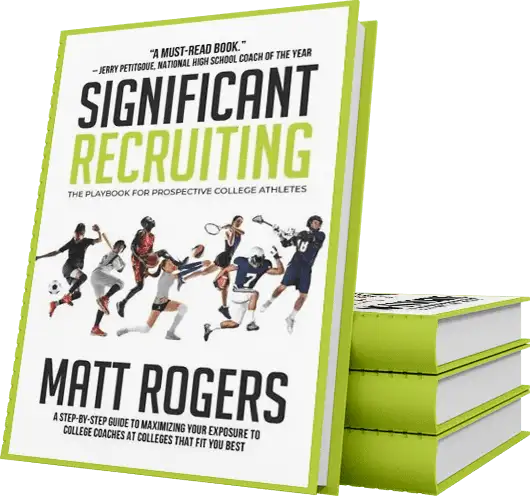
There you’ll find my book Significant Recruiting: The Playbook for Prospective College Athletes, along with the Recruit’s Journals designed to help athletes organize their recruiting journey, prepare for conversations with college coaches, and reflect on what truly matters when choosing a school.
You’ll also find the Significant Recruiting Launchpad classes, where I walk families step-by-step through the recruiting process so athletes can take ownership of their journey instead of leaving it up to chance.
And if you’d like help thinking through your own recruiting path, you can schedule a free recruiting strategy session with me directly on the website.
Finally, if your school or community would like to host a conversation about recruiting, leadership, and preparing students for the transition from high school to college—just like Konner’s superintendent did—you can also invite me to come speak to your students, families, and coaches.
Everything you need to get started is at:
coachmattrogers.com
Because every recruit deserves the chance to reach the point where Konner did.
The point where the opportunity is real.
And the only thing left to decide…
is what kind of trophy they want to chase.