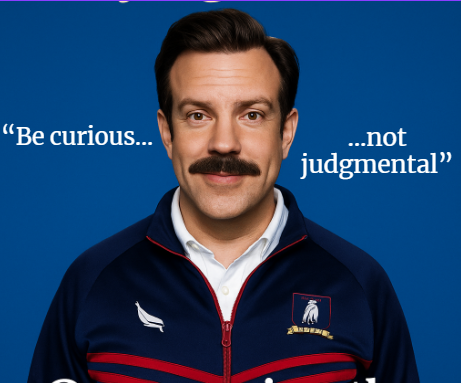
“Be curious, not judgmental” – Ted Lasso
Nobody likes to be called immature or told they’re working against their own potential. It hits our ego. It stings our pride.
How dare you? You don’t know me. You don’t know how hard I work.
Even when we take the time to look in the mirror, we often see what we want to see rather than the truth staring right back at us.
I’ve walked away from a couple of jobs over the years with my chest puffed out, convinced I had been wronged. I blamed the president. I blamed the AD. I blamed parents, resources, facilities, and budgets. I carried that list of obstacles like a résumé of reasons I couldn’t succeed.
And to be fair, many of those things were real challenges. My experience might have been better with stronger leadership or more proportional funding. I did have valid frustrations.
But when I look back now—honestly, humbly—I see something else just as clearly:
I was playing the victim card.
I was drowning in a pool I had filled myself.
When I zoom out, I can finally ask better questions:
I had great kids. I had a court, uniforms, balls, assistants, and a sport I loved with everything in me. So what did I really need to be happy? Why did I let what I didn’t have poison what I did?
The answer is simple.
And it’s not flattering.
I was immature.
I was undisciplined.
I didn’t always give my best.
And worse—I didn’t put my energy in the right places at the right time.
I let anger, disappointment, and self-doubt corrode what should have been a season of gratitude, purpose, and joy.
Victim mentality is a plague in sports and education.
If I’m being honest, it’s a plague in our entire culture—especially in our politics and social conversations.
Somewhere along the line we forgot that sports are supposed to be hard. If they weren’t, winning wouldn’t feel so meaningful. We tossed around clichés like “there’s no ‘I’ in team” so often that we forgot why they mattered in the first place.
Sacrifice is good.
Loyalty is healthy.
“All for one, one for all” isn’t outdated—it’s necessary.
Because “I won” is lonely when there’s no one to share the moment with.
I’m a big believer in the Ted Lasso quote above:
“Be curious, not judgmental.”
Curiosity invites solutions. Judgment locks us into the same place we started. When I judge, I hand over my power to change—my ability to influence, to grow, to lead.
There are people in life who have every right to feel like victims. Life can hit hard and unfairly. But in sports?
There are no victims.
There are winners and losers. There are good days and bad days. There are moments when the ball bounces your way and moments when it doesn’t. But if you choose to play, you choose to compete—and competition is never owed to you. It’s an opportunity, not a guarantee.
Every whistle, every serve, every pitch, every kickoff presents a chance.
And what you choose to do with that chance is the only thing that truly matters.
If this resonates with you…
If you’re a parent, athlete, or coach trying to grow beyond excuses and step into ownership, responsibility, and significance, I write about these ideas every week.
You can read more tools, stories, and coaching insights at CoachMattRogers.com — and join thousands of families and coaches working to build something better than success.