“It’s not the hours you put in your work that count, it’s the work you put in the hours.” – Sam Ewing
I just started some coaching sessions with a fantastic young Head College Coach (she’s going to be an amazing college coach and leader), and like I do with all college coaches I work with, I asked her what her recruiting strategy was.
Like most coaches, she started telling me about the recruits she has committed and where she’s been watching players play live.
She’s working hard. She’s passionate about doing it right. She’s getting commitments, but she’s trying to build a program from scratch and neither of those replies were a strategy and she knows it. The reason she’s going to be such a great coach is that she knows her weaknesses, but she is humble and excited to learn.
I used the word “significance” in my business name and in my books and recruiting resources for a reason. Significance implies removing chance from the equation. I don’t like athletes, parents, coaches, ADs or Presidents seeing the path to where they are going being driven by hope and prayer. Hard work, hope and prayer without a strategy often leaves people frustrated with their results.
But I thought it would do a lot of coaches good to start by asking themselves a few important questions that can help them begin building a recruiting strategy that actually fits their personality, staffing structure and goals.
Below are three questions worth your time.
1. Where can you find the most recruits every day without spending any money and very little time?
Recruiting sites often get a bad rap, but there is not a better place to find a volume of recruits without having to leave your office.
Over the past few months, I’ve had great conversations with the staffs at FieldLevel, College Pipeline, SportsRecruits and NCSA. They are all very different in what they do, but every one of them provides resources, search tools and databases that can save college coaches thousands of dollars and hundreds of hours every year.
I’m a huge believer in watching kids play live, so I am never going to tell coaches to put 100% of their recruiting time and resources into recruiting sites, but I think it is pure stubborn madness if coaches are not utilizing some of these services — which are free to college coaches — as a part of their daily recruit sourcing and pipelining.
I recently looked at NCSA’s women’s soccer database. There were over 49,000 active recruits listed and more than 27,000 of them had film attached to their profiles. Tell me where else you can find that volume of potential recruits with film every single day without leaving your office. The transfer portal doesn’t even give you that.
2. How are you organizing your recruiting daily, weekly, monthly, annually and then over a 4+ year period?
One of the big things I started doing as a young Head Coach 25 years ago was building spreadsheets that allowed me to track my roster and recruits in one place over a four-year period (or two years for you JC coaches).
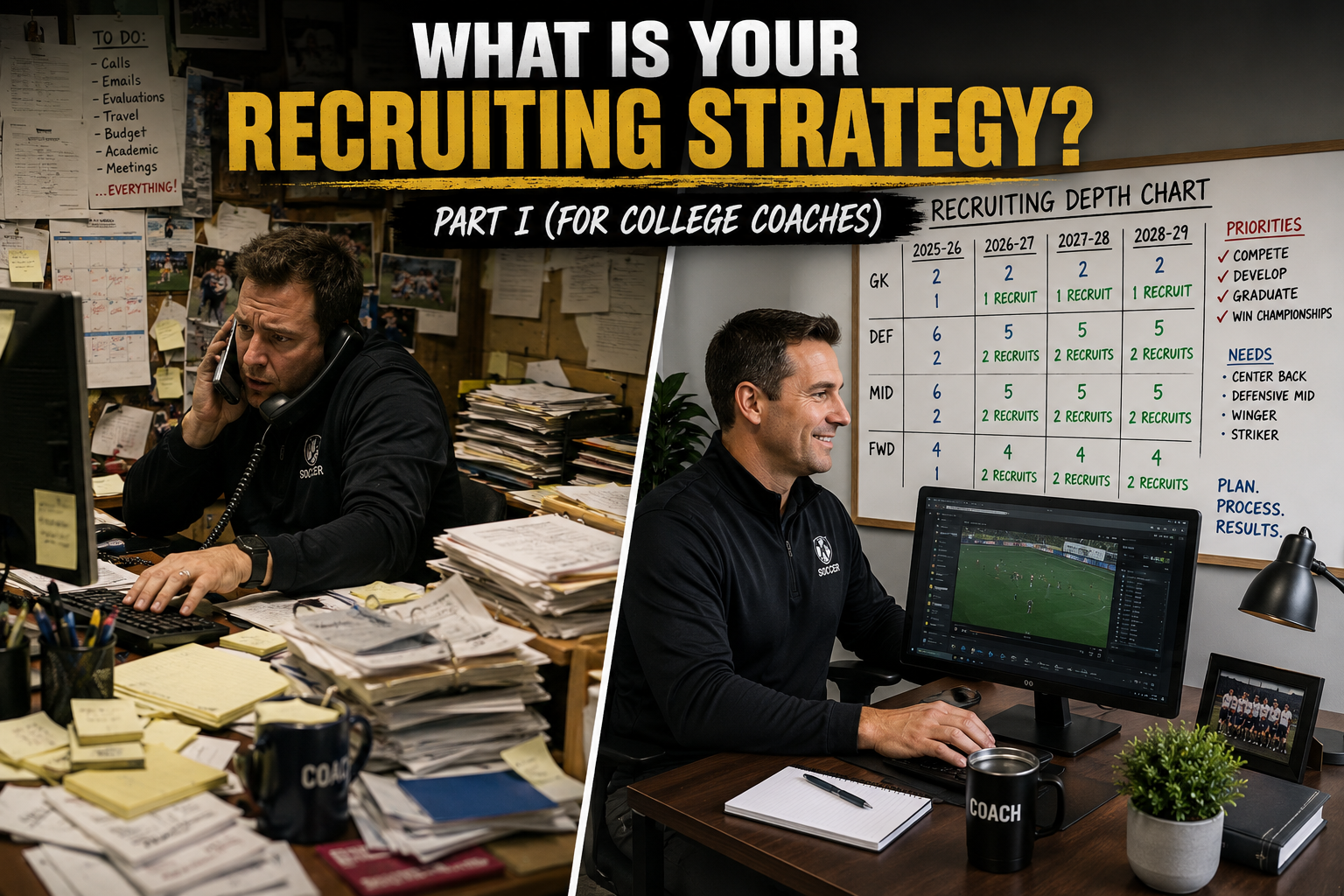
On the spreadsheets I create for college coaches, I have them organize their programs in three different ways.
First — Rank Your Roster
I know this may sound harsh to parents and athletes, but I have coaches rank their players from most important to least important to the success of the team right now. We color-code players by year in school and then project the following season’s roster after seniors graduate.
Once those seniors are removed, we immediately replace those spots with “Recruit + Class + Position” placeholders for the next year’s pre-ranking.
Why?
Because it forces coaches to constantly understand their needs before they walk into a gym, field, pool or tournament trying to recruit.
Too many coaches recruit talent instead of looking at their program holistically.
Second — Build a Depth Chart
We then organize the roster by position so coaches can clearly see what their competition and depth looks like at every spot.
It also forces us to think about the “what ifs.”
What if the starter gets hurt?
What if someone becomes academically ineligible?
What if somebody simply isn’t performing at the level expected?
Depth charts create perspective and expose weaknesses before weaknesses cost you games.
Third — Identify Program Needs
Finally, we create a goals list for the upcoming season.
How do we need to improve offensively?
Defensively?
Leadership-wise?
Athletically?
What hurt us this past season?
Those answers should directly impact the types of recruits you pursue.
Your recruiting strategy should solve problems within your program, not just collect talent.
3. What is your plan to use your time?
This is where executive function skills can turn a really good Xs and Os coach into a coach that consistently wins championships year after year.
The best coaches have recruiting plans for their assistants — even if “assistant” means a part-time coach making $3,000 a year or a graduate assistant getting free classes and showing up to practice every day.
That recruiting plan might be as simple as this:
Every Tuesday and Thursday, that assistant logs into your recruiting database, identifies five recruits that fit your needs academically and athletically, sends those recruits a strong “wow” email and attempts to set up a Zoom call with the recruit and family.
That assistant is now responsible for engaging 10 new recruits every week.
Multiply that by 50 working weeks in a year, and that’s 500 new prospects touched annually while only asking for the equivalent of maybe an hour or two per week.
The best coaches also have a recruiting plan for themselves. If you are asking your assistant to pipeline, that means you Mr./Ms./Mx. Head Coach needs to set aside time every single week to call those 10 recruits, schedule Zooms with their families and start building relationships.
Think about what we just created…500 new recruits identified…500 recruits communicated with…and between you and your underpaid and over-worked assistant, you’ve built communication and relationships with all of them while only spending the equivalent of 2-3 organized hours per week doing it.
That’s strategy.
That’s how programs start removing chance from the equation instead of simply hoping recruiting works itself out.
And honestly, this is just the bare basics.
This is the kind of foundational recruiting structure I help build for JC, NAIA and Division III coaches who are already being asked to recruit, coach, manage budgets, teach classes, oversee fundraising, engage alumni and wear ten different hats every day.
When you’re ready to stop simply hoping recruiting works and start building an actual recruiting strategy, I’m ready to help. Click “Contact” at coachamattrogers.com and schedule your discovery session today.